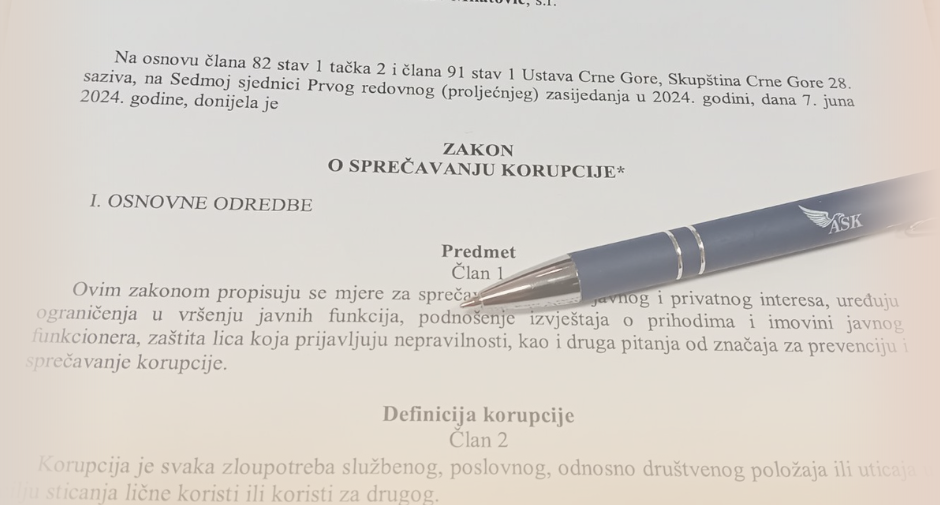
The Agency for Prevention of Corruption, in cooperation with the Ministry of Justice, organized three roundtables to discuss future amendments to the Law on Prevention of Corruption. These events gathered a wide range of experts from the Ministry of Justice, the Agency for Prevention of Corruption (APC), relevant state institutions, the non-governmental sector, and the media. The participation of international partners and experts, facilitated by the embassies of the United States, France, the United Kingdom, and the Delegation of the European Union in Montenegro, added significant value to the discussions by sharing their experiences and recommendations.
The outcomes of these round tables have been shaped into concrete recommendations that have been submitted to the Working Group for drafting the Law, in which APC representatives also participate. This process confirms the Agency's commitment to contributing, through a comprehensive and expert approach, to the further development of a transparent and efficient system for preventing corruption in Montenegro.
Below are key conclusions from the roundtables, regarding which it is necessary for the Working Group to make decisions and provide explanations in case of non-acceptance of the recommendations.
Round Table 1: Prescribed obligations of public officials and the scope of public functions in Montenegro
- The law should define who qualifies as a public official in Montenegro, in accordance with international standards in this field.
- A precise categorization of public officials should be established based on the relevance of their function and the level of corruption risk.
- The following individuals should be included in the category of public officials:
- Members of commissions conducting public procurement, privatization, public-private partnerships, and concession allocation procedures where the estimated value exceeds €100,000, with an obligation to submit income and asset reports to the Agency;
- Executives of public enterprises owned by other public enterprises;
- Presidents of sports federations, considering their management of significant financial resources.
- The possibility of excluding notaries from the category of public officials should be considered, as their only connection to public authority is their involvement in inheritance proceedings.
- The Agency should be tasked with determining conflicts of interest in the execution of public functions related to public procurement, privatization, public-private partnerships, and concessions.
- The concept of public officials' lifestyle should be clearly defined (consumption habits, place of residence, etc.), along with the Agency’s authority to monitor lifestyle and refer cases to the prosecution and police.
- Public officials should be required to declare the assets of immediate family members, regardless of whether they reside in the same household.
- Public officials should be obligated to declare actual ownership, regardless of whether they are officially registered as owners, including trusts held domestically and abroad.
- The obligation to report digital assets, such as crypto currencies, should be introduced, as well as the legal recognition of crypto currencies as a form of property.
- Public officials, their spouses, and children should be required to report loans and receivables from individuals and legal entities to the Agency.
- Public officials should be required to submit contracts for acquired assets and notarized records on the origin of property to the Agency.
- The scope and authority of the APC Council should be reconsidered and potentially expanded.
- A two-tier system within the APC Council should be introduced, and stricter criteria for appointing the Director and Council members should be established.
- The law should ensure better integration of databases relevant to the Agency’s work (e.g., linking with data from the Central Bank of Montenegro).
- The post-public office restriction period should be extended from one year to two years, in line with international standards.
- The current provision of the Law on Prevention of Corruption prohibiting public officials from signing service contracts with state-owned legal entities (Article 16, paragraph 1) hinders professional activities, such as public officials delivering expert lectures at state institutions for remuneration.
- The requirement to transfer management rights in private companies (Article 12) often creates barriers for businesspeople, particularly in smaller communities, to engage in local governance and administration.
- Regulations on gifts received by public officials should be clearly defined.
- When drafting legal provisions, the needs of prosecutors should be taken into account to facilitate the criminal prosecution of public officials.
- The law should impose stricter penalties for submitting inaccurate income and asset reports (in the U.S., "falsification of asset declarations" is a criminal offense).
- The possibility of establishing Integrity Offices in all ministries and at the local level should be considered to enhance corruption prevention efforts from the grassroots level.
Round Table 2: Whistleblowers reports and whistleblowers protection
- A separate Whistleblower Protection Law should be adopted in 2025.
- The analysis of the previous Law on Prevention of Corruption regarding whistleblowers, developed with the support of the Council of Europe, serves as a solid foundation for improving future legislation.
- The focus should be placed on the public interest, extending beyond corruption to include irregularities in food safety, environmental protection, and other areas.
- The possibility of criminalizing retaliation against whistleblowers, in cases of severe harm, should be explored (e.g., Cyprus, where criminal sanctions are imposed for retaliation against whistleblowers).
- The law should clearly define support mechanisms for whistleblowers, considering the potential pressures from employers following a report.
- Competent institutions should be legally required to act promptly on whistleblower protection requests.
- The possibility of reintroducing administrative protection for whistleblowers under the Agency as a preventive mechanism should be considered.
- The feasibility of financial rewards for whistleblowers whose reports result in financial recovery should be assessed to encourage more disclosures.
- The Agency should strengthen its role in corruption prevention and public education, serving as a reference point for whistleblower reports.
- The future law should clearly define the Agency's responsibilities and strengthen judicial protection, drawing from best practices in the EU and U.S.
- Effective whistleblower protection measures should be ensured, as mandated by the EU Whistleblower Protection Directive, which the current law fails to provide.
- Employers’ internal whistleblower handling personnel must be properly trained, which is not the practice currently; the new law should include precise provisions on this matter.
- Public perception must be shifted to eliminate the stigma surrounding whistleblowers, one of the biggest challenges in Montenegro.
- The law should define whether whistleblower status is time-limited and establish a clear protection period.
- Legal assistance should be provided to NGOs supporting whistleblowers.
- The current provision introducing a misdemeanor penalty for malicious reporting should be reviewed.
- Institutions and legal entities should be legally required to notify the Agency of the number of internal whistleblower reports received.
Round Table 3: The role of the APC in the anti-corruption system
- The functional, operational, and financial independence of the Agency for the Prevention of Corruption must be ensured.
- As a key institution in corruption prevention, the government must create conditions for its stable, professional, and effective operation.
- Efforts should be intensified to build public trust in the Agency’s work.
- The application of the Law on State Employees and Civil Servants should be reinstated for Agency employees to ensure independence and professionalism.
- In line with GRECO recommendations, an independent employment model should be identified.
- The Agency lacks 50% of the required staff under the new systematization but can only hire eight new employees in 2025 due to budget constraints.
- The latest UN report on the implementation of the Anti-Corruption Convention highlights the need to strengthen human and financial resources.
- The salaries of Agency employees must be addressed to ensure full execution of their responsibilities.
- The compatibility of new legal provisions with other relevant laws must be ensured (e.g., data protection and banking laws).